Profile diagram
Profiles represent user-defined extensions or restrictions of the UML metamodel. They can be created using Profile diagrams.
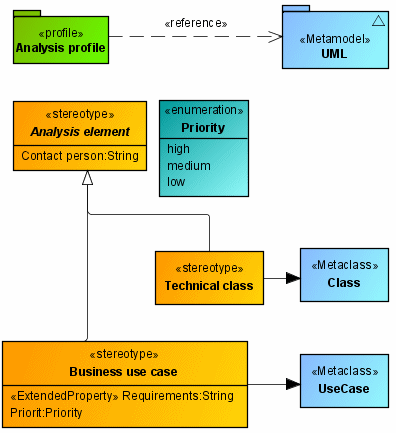
Figure 12 shows a Profile diagram for defining a simple profile for object-oriented analysis.
On the left-hand side, the diagram contains the Analysis profile, which defines the two stereotypes Technical class and Business use case. Both of these inherit from an abstract stereotype Analysis element, which defines the Contact attribute. In addition to the stereotypes, the profile also defines an enumeration called Priority, which is used as a type by the attribute of the same name for the Business use case stereotype.
The right-hand side of the diagram contains the UML metamodel and two of its metaclasses. The profile has a relationship of the Metamodel reference type to the metamodel. Strictly speaking, it is a relationship of the UML type PackageImport, which is referred to as a metamodel reference in this context and is also displayed in the graphical view with the keyword «reference» instead of «import». This relationship is always necessary if all UML content is to be available within packages to which the profile is assigned.
The two stereotypes Technical class and Business use case have a relationship of the UML type Extension with the Class metaclass or the UseCase metaclass. This relationship specifies the UML elements to which the stereotype can be assigned.
The attributes of a stereotype are available as additional properties for the UML elements to which the stereotype is assigned. In this example, a use case with the «Business use case» stereotype has the additional properties Contact and Priority in addition to the properties defined by the UML specification.
UML profiles contains more information about profiles and stereotypes.