Group and object properties of UML elements
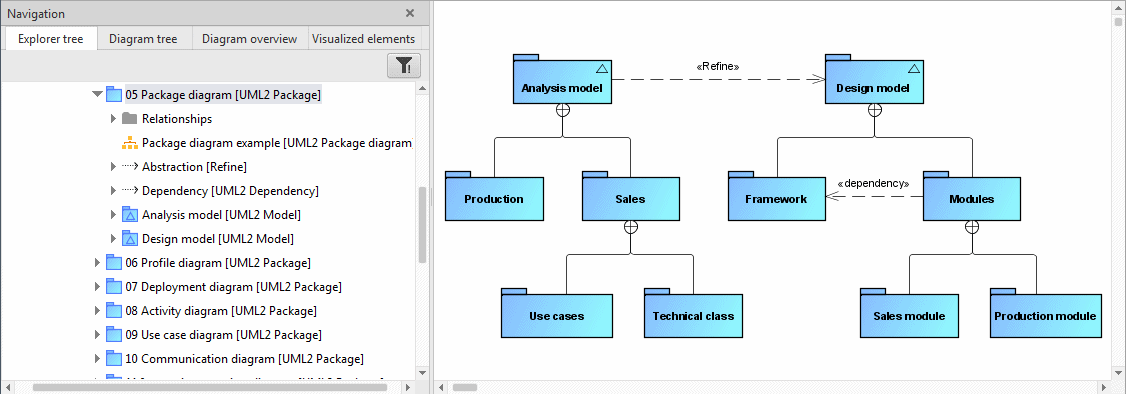
Figure 160 shows a hierarchy of packages with a diagram in the Explorer tree on the left, and a package diagram with packages and their relationships with one another on the right.
Both sides show aspects typical of various ARIS types for packages.
The package hierarchy shows typical features of an ARIS group hierarchy. Just as ARIS groups can contain other ARIS groups, ARIS objects, and ARIS models, UML packages can also contain other UML packages and UML diagrams. Therefore, it would be obvious to map UML packages to ARIS groups.
By contrast, the diagram shows typical features of ARIS objects. Just as ARIS objects can be contained in ARIS models as object occurrences and can be linked to one another by connections, UML packages are contained in the diagram as element presentations and are linked to one another by edges. Looking at this aspect alone, it would be obvious to map UML packages to ARIS objects.
This contradiction in the mapping of UML to ARIS has been resolved by assigning the ARIS type Group all properties of the ARIS type Object. This means that groups have an object type, they can have occurrences in diagrams, and they can be linked to one another by connections.
As every UML element can ultimately contain other UML elements (every UML element can own elements of the UML type Comment) and many elements can also own diagrams, UML elements are mapped to groups of the relevant UML type in ARIS.
For example, this means that a use case is saved in ARIS as a group with the object type OT_UML2_USE_CASE. This mapping applies to all UML elements, regardless of their appearance in diagrams. A generalization, shown graphically as an edge in diagrams, is also saved in ARIS as a group with the object type OT_UML2_GENERALIZATION.
The exceptions are certain elements that normally appear right at the bottom of the element hierarchy and, at the same time, occur frequently. Examples of these elements are LiteralInteger and LiteralUnlimitedNatural. They are normally used as the lower or upper limit for multiplicities on association ends and attributes.
To ensure that management of user privileges does not become too fine granular, the possibility of defining user privileges has been restricted to UML elements of the Package, Model, and Profile types.
The behavior of conventional groups has not changed in ARIS. They have the object type Group (OT_GROUP). For groups of this type, there is still no facility for them to occur in diagrams or to be linked by connections.