Specifying the navigability of an association end
As described in Associations , the navigability of an association end is not a simple Boolean property, but depends on what the association end belongs to and, in some cases, the way in which the association end is assigned to its owner.
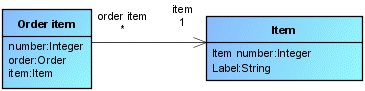
Figure 132 shows two classes and an association. The item association end is navigable (indicated by the arrow head), as it is an attribute of the opposite class Order item. You can recognize this by the graphic representation with the dot at the arrow head, and also by the fact that it is listed in the class as an attribute. Attributes that are simultaneously association ends are not normally also displayed in the attributes area of the class in the diagram. However, you can change this for the class by disabling the Classifier > Hide association member ends display option, which has been done here to illustrate the situation.
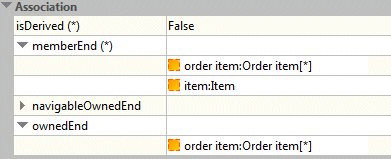
In the properties of the association, you can see that only one of the two association ends belongs to the association – the order item association end. As it is only listed for the ownedEnd property but not for the navigableOwnedEnd property, it is not navigable.
You can use the pop-up menu for the association end or the tab bar to easily change its navigability without having to manually make changes to the ownership relationships.
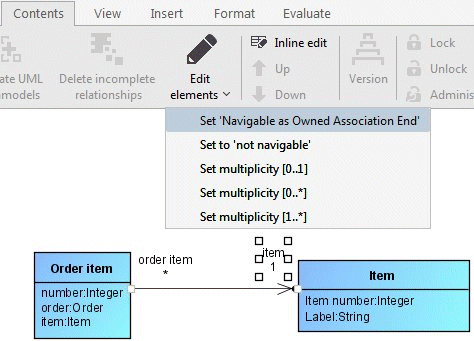
Figure 134 shows the UML-specific functionalities for an association end. The current status of the element is hidden in the list (Set 'Navigable as Owned Association End' and Set multiplicity [1..1]).
Selecting Set 'Navigable as Owned Association End' in the list displays the following screen:

The item association end is still navigable, but is no longer an attribute of the Order item class. This can also be seen from the changed properties of the association. The item association end is now listed for both the ownedEnd property and the navigableOwnedEnd property.
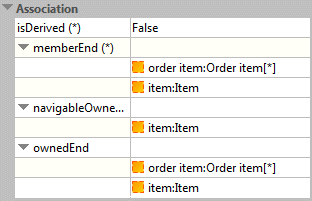
The functionalities for changing the navigability thus save the user having to manually edit the ownedAttribute property for the class at the opposite association end and the ownedEnd and navigableOwnedEnd properties for the association.