Root
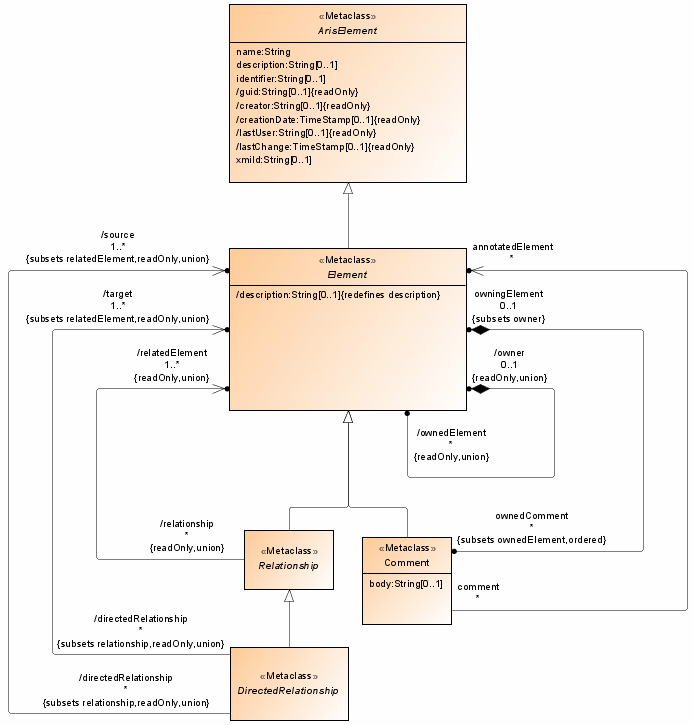
Figure 26 shows the Root diagram from the UML specification, supplemented with ARIS-specific extensions. The metaclasses from the UML metamodel form an inheritance hierarchy with the abstract metaclass Element at the top. In this context, "abstract" means that there are no UML elements of the Element type, only that properties are defined here for other element types that inherit from Element. Abstract classes in UML diagrams are indicated by the name being written in italics.
In ARIS UML Designer, the UML metaclass Element inherits from an abstract metaclass ArisElement. This means that all UML elements are extended with ARIS-specific properties such as creator, creationDate, name, description, and identifier. A slash / in front of an attribute name means that its value is derived from other properties at runtime. This also applies to ARIS properties such as creator or GUID, as they are not mapped internally to ARIS attributes but result directly from the ARIS object.
The non-abstract Comment metaclass inherits from the Element metaclass. Each UML element can have any number of these comments through its ownedComment property. In turn, a comment can refer to any number of UML elements through its annotatedElement property.

Comments are displayed in diagrams as a rectangle with a turned-down corner. The text within the comment shows the value of the Comment::body property. The Comment::annotatedElement property is shown as a dotted edge to the annotated element in the diagram (see Figure 27).
The Element::/description property also represents an ARIS-specific extension of the UML metamodel. It redefines the ARIS property ArisElement::description for UML elements by deriving the description from the first comment that the Element has. For this purpose, the isOrdered flag is set for the Element::ownedComment in ARIS UML Designer, while the UML metamodel does not originally provide ordering here. This means that UML elements have the ARIS property description in ARIS UML Designer. However, its value is not lost when exchanging data with other tools via XMI as it is saved as ownedComment for the element. Conversely, it means that every UML element that is imported into ARIS UML Designer via XMI and has a comment automatically has a value for its description property.
The Root diagram in Figure 26 also shows that in theory every UML element can have other UML elements. For this purpose, Element defines two properties /owner and /ownedElement. Both of these are so-called derived unions. This means that you can ask an element for its owner or the elements it contains, but other properties of the Element type and its specializations specify the way in which the element can contain other elements, or the way in which it can be contained in another element. An initial example of this is included in the same diagram. For the Element::ownedComment property there is subsets ownedElement and for the Comment::owningElement property there is subsets owner. This means that whenever an element is asked for the value of its ownedElement property, the values it returns include the value of the ownedComment property, that is, the comments that it has. The same applies to asking a comment for its owner property. In this case the value of the owningElement is returned.
In addition, the Root diagram contains the two abstract metaclasses Relationship and DirectedRelationship. All metaclasses that primarily define semantics for relationships between elements inherit from these classes. These relationship elements are frequently shown as graphic edges in diagrams. This metamodel concept includes the two metaclasses Generalization and Association as examples of these relationship types.