Class diagram
Class diagrams primarily show relationships between classes and their properties.
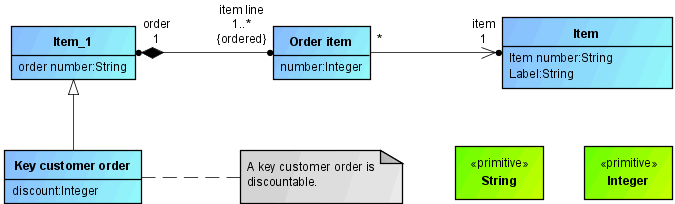
The image above shows a simple Class diagram with four classes Order, Key customer order, Order item, and Item, two primitive data types String and Integer, and a comment. The classes each contain one to two attributes (UML type Property). For example, the Order class contains the Order number attribute, which is of the Integer type. This means that the order number is a property whose value is a whole number.
UML itself does not stipulate which data types are to be used when modeling and how they should be denoted. One exception is the modeling of profiles in ARIS UML Designer, where the corresponding types specified by UML have to be used for primitive data types. In the example above, the two types String and Integer could also be called Character string and Whole number.

The Order and Order item classes are linked together by an association. This association has an association end order with the multiplicity 1 and an association end itemline with the multiplicity 1..*. The multiplicity 1..* at the itemline association end means that at least one and up to any number of order items are assigned to an order. The property {ordered} specifies that the order items are assigned to the order in a particular sequence. The multiplicity 1 at the order association end means that an order item is always assigned to only one order.
The black diamond on the association indicates that the order items are part of the order and if an order is deleted its order items will also be deleted automatically.
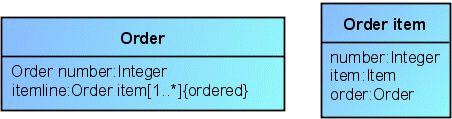
The two black dots at the end of the association edge mean that the corresponding association ends are simultaneously attributes of the respective opposing class. Figure 3 therefore shows a semantically equivalent alternative appearance of Figure Association between two classes. The order attribute for the Order item class is displayed within the class without specifying its multiplicity 1 as the value 1 is the default value for multiplicities and it is not normally displayed within classes.
An arrow head at an association end means that the association is navigable in the direction of the arrow. The following image shows an association that is only navigable in one direction.

In this example, the order item knows which item it relates to. Conversely, the item has no knowledge of the order items by which it is used.
An association end is classed as navigable if it is simultaneously an attribute of the opposite class. There is another method of specifying the navigability of an association end. However, it will not be discussed here. If both ends of an association are navigable, there is no need for you to display the two arrows in the diagram (see figure Association between two classes).
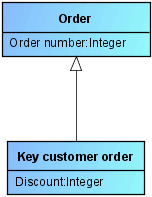
The image above shows a generalization relationship between the Key customer order and Order classes. This means that the Key customer order class is a specialization of the Order class and thus inherits all properties from it.